
Physical security and cybersecurity used to be two completely separate jobs. Physical security teams managed cameras, access control, and door hardware, and that starts with access control lifecycle management. Our physical security glossary walks through this. All of it depends on access control history. This is one part of physical security lifecycle management — our full guide covers how the stages fit together. IT managed firewalls, networks, and endpoints. Different budgets, different reporting lines, different threat models.
That division made sense until physical security devices got IP addresses and became part of the same attack surface as your IT environment. Attackers noticed quickly.
According to the FBI, cyber-physical incidents more than doubled since 2025. Unlike traditional cyberattacks that focus on data theft, these attacks target systems like water plants, power grids, and data centers, with physical threats sometimes targeting staff.
For Physical Security Directors, the implications are significant. The devices you manage are no longer just hardware. They’re networked endpoints with firmware versions, vendor credentials, and lifecycle timelines that carry real cyber risk.
Here’s where cyber-physical risk is already showing up inside your physical security program and what to do about it.
What is security convergence?
Security convergence is the strategic integration of physical security surveillance, access control, door hardware and cybersecurity into a single, unified program.
In practice, that means the teams, tools, and processes that govern your physical security infrastructure don’t operate independently from your IT security program. They share visibility, coordinate on risk, and align on decisions like vendor access, device lifecycle, and firmware governance.
Convergence doesn’t require a reorganization. But it does require shared visibility into the same data and a clear-eyed understanding of where the gaps between those two worlds are creating risk right now.
Physical security directors are caught in the middle.
In most organizations, physical security sits under operations or facilities. Cybersecurity sits under IT or the CISO. That structural divide creates a set of problems that nobody owns which means nobody fixes them.
| Category | Physical Security (Facilities/OPS) |
Cybersecurity (IT/CISO) |
| Reporting line | Reports to CSO or COO Viewed as a “cost center.” |
Reports to CIO or Board Viewed as “risk management.” |
| Primary challenge | Needs “always-on” access for vendors to maintain cameras and sensors. | Blocks unauthorized devices to protect the corporate backbone. |
| Organizational “Silo” | Device purchases, vendor access, and maintenance decisions are made without cybersecurity input or review. | Networked cameras, access panels, and intercoms often fall outside standard IT asset management and monitoring. |
| Convergence solution | Device purchases, firmware updates, and vendor access decisions are reviewed jointly with IT with a shared system of record that keeps both teams working from the same asset data. | Physical security devices are treated as managed endpoints tracked, monitored, and included in standard vulnerability and lifecycle management processes. |
Most Physical Security Directors aren’t losing sleep over abstract concepts like convergence. They’re losing sleep over audits, vendor access, aging hardware, and devices they can’t fully account for.
Here are the four areas where cyber-physical risk is most likely hiding in your program.
-
Networked devices are a shared attack surface.
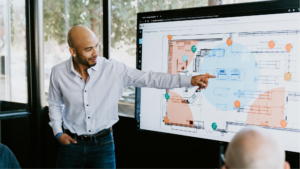
Every IP camera, access controller, and intercom on your network shares infrastructure with your IT environment. Modern physical security systems are built this way, and it carries a risk that most physical security programs aren’t designed to manage.
A poorly secured device creates an entry point. Attackers can use it to move laterally, pivoting from that device into other systems on the same network. Your camera becomes their foothold into your broader IT environment.
The risk sits in the space between two teams. Physical security controls the device. IT controls the network. When those teams aren’t aligned on patching schedules, network segmentation, and access policies, nobody fully owns the exposure and unowned risk has a way of compounding quietly until it doesn’t.
-
Firmware is the new patch management problem.

IT teams have long understood that software needs to be updated regularly. Physical security hardware operates under a different assumption devices get installed, commissioned, and left alone for years.
Device manufacturers release firmware updates on a regular basis, patching known vulnerabilities as they’re discovered. Without visibility into what firmware version each device is running across your estate, you have no way of knowing which assets are exposed and no way to make a defensible case for your security posture to leadership or auditors.
A simple question worth asking your team…Do you know the current firmware version on every camera across your facilities?
If pulling that answer together takes more than a few minutes, your program has a visibility gap that’s worth closing sooner rather than later.
-
End-of-life hardware creates compliance risk.
When a manufacturer stops supporting a device, security patches stop coming with it. An end-of-life camera or access panel carries real compliance and operational risk the kind that shows up as findings in a security audit.
In regulated industries like healthcare, finance, education, and government, running unsupported hardware is a liability that auditors are trained to find. EOL devices are known targets precisely because their vulnerabilities are documented and unpatched attackers don’t have to work very hard to exploit what’s already publicly known.
The harder problem is visibility.
Most teams have EOL devices scattered across their portfolio without a clear picture of what needs to be replaced, where it lives, or when the clock runs out.
Lifecycle management done through spreadsheets and institutional memory isn’t a system, it’s a gap waiting to be found.
-
Vendor access is a cyber risk vector.
Integrators, technicians, and service contractors need access to your systems to do their jobs. That’s a normal part of running a physical security program at scale. It’s also one of the most common initial attack vectors in enterprise breaches.
- Who has remote access to your VMS?
- Which technicians have credentials to your access control system?
- When did those credentials last rotate?
For most physical security programs, those questions don’t have quick, clean answers because vendor access is managed through a combination of spreadsheets, email threads, and institutional memory.
Third-party access managed through informal processes creates exactly the kind of undocumented, unaudited gaps that attackers look for. The vulnerability isn’t the vendor, it’s the absence of a system for managing what they can access, for how long, and under what conditions.
From reactive silos to unified lifecycle management.
The organizations getting ahead of cyber-physical risk aren’t waiting for a breach to force the conversation. They’re building the infrastructure to manage risks together, deliberately and before something goes wrong.
SiteOwl gives physical security teams the visibility and documentation infrastructure to manage their programs with the rigor this environment demands from living floor plans and accurate as-builts to lifecycle dashboards that make EOL planning and capital forecasting a data-driven exercise.
Your program is already operating in a cyber-physical environment. The only question is whether your systems reflect that reality.
Request a demo to see how SiteOwl gives your program the visibility it needs to stay ahead.