
Table of Contents
- Rethinking Physical Security Design Standards
- Why Standardization Is the Foundation for Achieving Stronger Outcomes
- Standardization Drives Stronger Security Outcomes
- Modern Security Design Across Industries
- Four Pillars of a Standardized Security Design Process
- Designing for Real-World Risks
- Stronger Security Starts with Standardized Design
Security design is often where projects succeed or fail. Delays, budget overruns, and performance issues can all be traced back to the way systems are planned and documented at the start.
As physical security environments become increasingly complex, the need for consistent design practices is more important than ever. Teams that rely on scattered files or informal processes find it harder to keep projects aligned, efficient, and accurate.
In this first installment of our Solutions Series, we explore how leading security teams are rethinking design and why standardization is the foundation for achieving stronger outcomes.
Rethinking physical security design standards
Anyone who’s worked on a security project knows how messy design standards can get. A major factor is the industry’s reliance on manual documentation and informal collaboration.
The data tells the story. A 2022 benchmark report found that 70% of security teams still depend on manual processes during the design phase, creating vulnerabilities that ripple downstream. In practice, that often looks like:
- Floor plans passed around as static PDFs with no version control
- Device specifications stored in email threads or personal folders
- Field teams relying on memory to replicate past installs
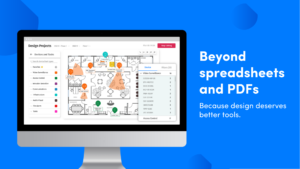
Design standards shouldn’t live in spreadsheets or get passed down by word of mouth. Yet for many teams, that remains the norm.
Files are scattered across shared drives. Device choices are based on memory or personal preference. And when a key team member leaves, so does critical system knowledge.
Over time, these improvisations pile up:
- A camera model used once becomes the default everywhere.
- Hand-drawn layouts vary by team, region, or individual style.
- Specs live in inboxes instead of a shared system.
Informal processes may work for small construction projects, but today’s physical security environments are larger, more distributed, and higher risk. Without clear design guidelines, inconsistencies become a liability for stakeholders managing complex facilities.
Standardization drives stronger security outcomes
Every successful security project starts with clarity, but too often, that clarity is missing. 68% of security managers report that ad-hoc documentation is the primary source of project delays and costly rework.
Standardization provides that clarity by giving teams a common framework to design, build, and maintain systems. Without it, projects rely on individual habits, scattered documents, and one-off decisions that rarely scale.
Standardization creates several critical advantages:
Consistency across sites
Standardization transforms security from a patchwork of local practices into a predictable, repeatable process. When device selection, layouts, and documentation follow the same rules across facilities, performance becomes consistent whether at a single site or across an entire enterprise.
It also establishes a shared language for everyone involved. Field technicians, project managers, and external vendors can all align around the same standards, reducing confusion and ensuring smoother execution from start to finish.
Efficiency in delivery
Repeatable templates and clear guidelines reduce design time, minimize errors, and keep projects moving forward without unnecessary rework. Teams spend less time debating specs or redrawing layouts and more time focused on execution.
For executives and project managers, this efficiency brings better visibility into progress, bottlenecks, and overall performance.
Alignment with stakeholders
Clear standards extend to external vendors and consultants. When everyone knows what’s expected, ambiguity disappears, reducing project overruns and avoiding inflated costs. Standards also make it easier to hold third parties accountable, because expectations are transparent and measurable.
Confidence in outcomes
When every team member works from the same foundation, systems are easier to deploy, simpler to audit, and more resilient over time. Standardization builds trust in the design phase and creates stronger outcomes in the field.
Security design across industries
Physical security environments demand more than patchwork standards and scattered files. An effective design process is structured, collaborative, and built to scale across multiple sites and teams.
Without it, organizations risk vulnerabilities that can lead to unauthorized access, compliance failures, or costly rework.
Standardized methodologies address these challenges by combining clear design guidelines, risk assessment, and collaboration between stakeholders at every stage of the project.

Imagine completing some of these projects without a robust security design process:
Financial sector: Credit union security and compliance
Credit unions and banks face strict security requirements while operating across multiple branches with high customer traffic.
Informal designs can result in inconsistent coverage, gaps in surveillance systems, and compliance issues during audits. A robust security plan ensures every branch is aligned with physical security standards.
- Clear standards safeguard sensitive areas like ATMs, vaults, and teller stations.
- Consistent documentation simplifies compliance and audit readiness.
Transportation & logistics: Securing warehouses and distribution hubs
From warehouses to distribution centers, these environments depend on speed and precision. Without standardization, layouts vary, cabling is inconsistent, and blind spots appear in parking lots and high-traffic areas. A standardized process ensures every facility follows the same design guidelines for access control systems and surveillance.
- Consistent layouts improve visibility and life safety across busy facilities
- Standardized designs simplify maintenance and reduce downtime.
Critical infrastructure: Securing utilities
Utility facilities require precision in both design and operation. Missing specifications for alarm systems, vehicle barriers, or intrusion detection systems can introduce vulnerabilities and raise compliance risks.
- Detailed standards strengthen both physical security measures and regulatory compliance.
- Centralized records simplify oversight, upgrades, and long-term risk management.
Forward-thinking security leaders in every sector from financial institutions to logistics providers rely on a centralized, mobile platform to reduce risk, align teams, and scale without compromising quality.
Physical security system design process
Physical security projects succeed or fail long before the first device is installed. The design phase sets the tone, and when it’s inconsistent or fragmented, the problems ripple downstream into installation, compliance, and long-term maintenance.
Versatile security teams are rethinking how design gets done. Instead of relying on scattered files or ad-hoc processes, they’re adopting structured, repeatable methodologies that create alignment from the very beginning.
This approach improves collaboration among stakeholders, keeps construction projects on schedule, and ensures security requirements align with building codes and life safety standards.
With a standardized framework, organizations can standardize device choices, build designs more efficiently, and reduce vulnerabilities across sensitive areas. These practices form the four pillars of an effective physical security design process.
Four pillars of a standardized security design process
1. Create clear standards
When details like part numbers, manufacturers, and compatible accessories are built into the standard, guesswork disappears. Effective teams begin with a shared foundation that keeps every project aligned from the start.
Standardized device templates, naming conventions, and layout guidelines ensure that every project begins with the same level of precision.
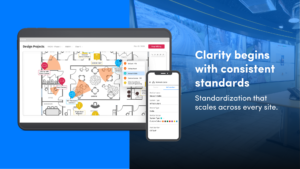
Operational impact: Consistency across projects, faster onboarding for new team members.
2. Build designs efficiently
Dragging devices into a floorplan should be fast, accurate, and repeatable. Digital tools paired with standard templates allow teams to reduce design time while limiting errors.
The focus shifts from redrawing cabling diagrams or card readers to refining coverage for access control systems, intrusion detection systems, and surveillance systems.
Efficiency impact: Quicker turnarounds and more time for value-added design decisions.
3. Collaborate across teams
Security design isn’t just an engineering task. IT, facilities, and integrators all need visibility and input. Collaborative design platforms make the process simultaneous and transparent, ensuring changes are reviewed, approved, and implemented without endless back-and-forth.
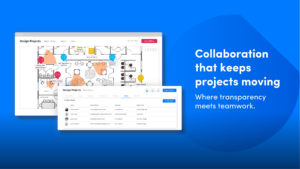
Operational impact: Shorter review cycles, better alignment between stakeholders.
4. Reduce errors and mitigate risks
Mistakes in the design stage are costly later. Scaled floor plans, visual coverage tools, and validated specifications for alarm systems, intercoms, and video surveillance reduce the chance of oversights. By addressing potential vulnerabilities early, organizations strengthen emergency preparedness and ensure compliance with physical security standards.
Risk impact: More reliable installations, safer environments, and stronger long-term security management.
Security design doesn’t have to be complicated, slow, or inconsistent.
By centralizing the process, teams gain the clarity to collaborate effectively, avoid friction, and deliver systems seamlessly from start to finish.
Designing for real-world risks
A physical security system is more than cameras, access control, or software dashboards. It must account for on-site realities that shape day-to-day security operations and long-term resilience.
Different organizations prioritize different risks.
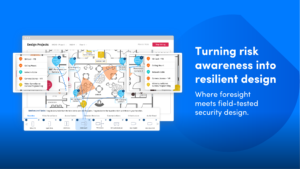
A university campus may focus on Crime Prevention Through Environmental Design (CPTED), using landscaping, lighting, and traffic flow to guide movement and reduce opportunities for crime.
A financial institution may emphasize restricted areas and secure areas, with strict controls around vaults, teller stations, and emergency exits. Operators of high-risk infrastructure, like utilities or data centers, often concentrate on standoff distances, vehicle barriers, and redundancies in power supply to withstand forced entry or outages.
Even small details matter. Signage, well-lit stairwells, or properly marked emergency exits can reduce vulnerabilities and help security personnel manage incidents more effectively.
Standardization pulls all of these considerations into one framework, turning risk mitigation from an afterthought into an integrated part of the security plan.
Stronger security starts with standardized design
Across industries, one theme is clear: patchwork design processes cannot keep pace with today’s demands. Manual files, informal standards, and siloed collaboration create risks that lead to costly delays, compliance gaps, and inconsistent outcomes
The future of security design is structured and scalable. Standardization provides a common foundation. Digital tools accelerate the way designs are built. Real-time collaboration keeps every stakeholder aligned. Together, these practices transform design from a weak point into a strength.
When security design is standardized, projects move faster, teams remain in sync, and systems perform as intended, whether securing a single branch or rolling out across an entire enterprise.
Ready to see what a modern design process looks like in practice? Request a demo and explore how standardized security design can transform your projects.